
Automating RFQ Ingestion from Email and PDF for UAE Freight Forwarders
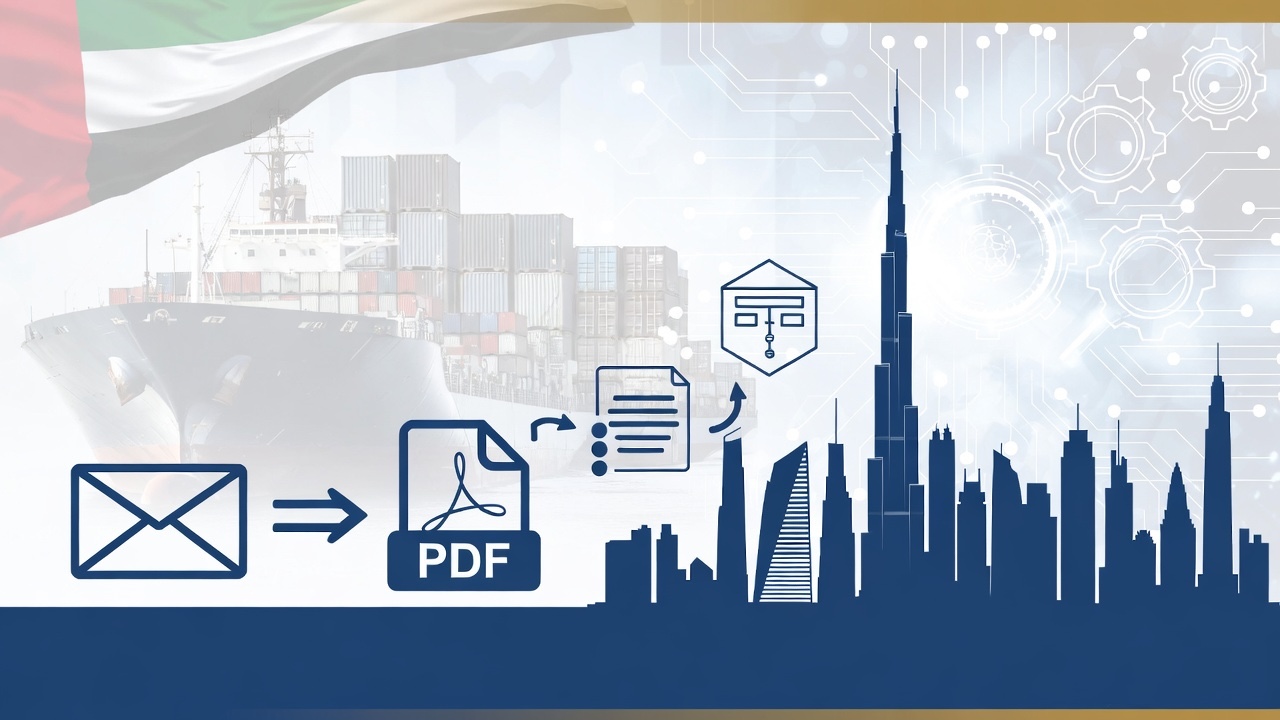
A UAE freight forwarder’s inbox doesn’t sort itself by format. One RFQ arrives as a structured Excel template from a shipping agency. The next comes as a paragraph buried in an email thread. The third is a scanned PDF with handwritten corrections. All three are legitimate procurement requests. All three require the same response. In most operations, someone must read, interpret, and manually re-enter the same information into a different system before a team can build a quote.
This is the RFQ ingestion problem for UAE freight forwarders — and it starts before any pricing decision is made.
Why UAE Freight Forwarders Accept Format Variability
The freight forwarding industry operates across a wide network of counterparties — shipping lines, customs brokers, trading companies, manufacturing facilities, and procurement teams across the UAE, GCC, and global trade corridors. Each sends RFQs in the format that works for their internal team, not the format that works for the freight forwarder receiving them.
Over time, freight forwarding operations adapt. Teams learn to read different formats. They develop informal conventions for interpreting ambiguous requests. They build workarounds for the formats that cause the most errors. The format variability becomes background noise — accepted as part of the job, rarely measured, and almost never challenged.
Industry data from WiseTech Global shows that manual document processing in freight forwarding takes between 10 and 60 minutes per document depending on complexity. Multiplied across a team processing 10 to 30 RFQs per day, format variability is not background noise. It is a significant, recurring cost hidden inside the operations budget.
The First 5–10 Minutes of UAE Freight RFQ Processing Are Pure Overhead
Before any commercial decision is made on an RFQ, there is a fixed overhead period that every operations team absorbs invisibly. This is the time spent understanding what the RFQ is actually asking.
It involves reading the full email thread to find the actual request. It involves opening the attachment and identifying whether it is a rate request, a spot quote, or a standing tender. Finding the origin and destination comes next — sometimes stated directly, sometimes inferred from shipment descriptions. The team must also verify whether dimensions, weights, or commodity codes are present, incomplete, or conflicting with what the email body states.
None of this is pricing work. None of it requires commercial judgment. All of it repeats, at the same level of effort, for every single RFQ that arrives — regardless of format, complexity, or value. Research from PRNewswire indicates employees spend more than 9 hours per week on manual data transfer tasks of this kind — overhead that compounds daily across every RFQ that arrives.
The Real UAE Freight RFQ Problem Is Unstructured Input — Not the Format
The common response to this problem is format standardisation — asking customers to use a template, or investing in OCR tools that extract data from PDFs mechanically. Both approaches address the symptom, not the cause.
The real problem is not that RFQs arrive in different formats. The deeper problem is that the information inside them is unstructured — its meaning cannot be determined from its position on the page alone. A field labelled “destination” in one customer’s template might be labelled “discharge port,” “delivery location,” or simply left implied in another’s. An OCR tool reads characters. It cannot interpret intent.
For UAE freight forwarders operating across multi-corridor routes — Jebel Ali to Rotterdam, Dubai to Mumbai, Abu Dhabi to Singapore — the structural diversity of incoming RFQs reflects the diversity of the trade lanes themselves. Standardising input from every counterparty is not commercially viable. Understanding it, regardless of format, is the only scalable solution.
What RFQ Ingestion Automation UAE Actually Does
RFQ ingestion automation reads, interprets, and converts incoming RFQ inputs — emails, PDF attachments, forwarded threads — into structured data objects that a pricing team or ERP can act on immediately, without manual interpretation or data entry.
The process runs in four stages:
Step 1 — Read and Interpret the Incoming Request
The automation layer monitors incoming email channels and identifies messages that contain RFQ intent — explicit rate requests, tender documents, or procurement attachments. It reads the full message context, not just the attachment, to establish what is being requested and from whom. Email threads, forwarded messages, and inline attachments all receive handling within the same interpretation pass.
Step 2 — Identify Key Fields Regardless of Position or Format
Rather than relying on fixed field positions — as OCR-based tools do — the system identifies shipment origin, destination, cargo description, dimensions, weight, commodity type, and service scope by understanding the meaning of the text, not its location. An RFQ that states “we need a rate from Dubai to Hamburg for 2 x 20ft containers of general cargo” and one that uses a formal template with labelled fields both receive processing with equivalent accuracy.
Step 3 — Detect Missing Data Before Anyone Else Does
Most RFQs that arrive manually require at least one follow-up to clarify missing or conflicting information. The ingestion layer identifies these gaps before the RFQ reaches the pricing team — flagging missing commodity codes, ambiguous port references, or incomplete cargo descriptions at the point of receipt, not after the first attempt at quoting. Early flagging reduces rework and shortens the overall quote cycle.
Step 4 — Convert to a Structured RFQ Object
The system converts interpreted data into a structured object — consistent field names, validated values, and a completeness indicator — that the pricing team can review, feed directly into an ERP system, or use as the basis for a draft quotation. The commercial team receives a pre-filled RFQ rather than a raw document. For the full downstream flow, see how Nunar connects RFQ ingestion to ERP posting.
The RFQ Understanding Layer for UAE Freight Forwarders — Why It Matters
The distinction between reading a document and understanding it is the difference between OCR-based automation and AI-powered ingestion. OCR extracts characters from a page. Understanding extracts meaning from language — including implied meaning, commercial context, and operational intent.
For UAE freight forwarders, this distinction is particularly significant. RFQs regularly arrive in Arabic, with mixed Arabic-English content, or with references to UAE-specific trade lanes, free zones, and customs procedures that require domain knowledge to interpret correctly. A system that reads without understanding will extract characters accurately and interpret them incorrectly.
The understanding layer allows the same ingestion system to handle an RFQ from a Jebel Ali-based trading company and an RFQ from an Abu Dhabi government procurement team — without manual configuration, template mapping, or format-specific rules for each counterparty.
What Changes for UAE Freight Forwarders
When a team deploys RFQ ingestion automation, the fixed overhead period at the start of every quote cycle disappears. The pricing team receives structured, validated RFQ data rather than raw documents. The first commercial decision — whether to quote, at what margin, and with which service configuration — happens earlier and with better information.
For teams processing 10 to 30 RFQs per day, this compounds quickly. The time recovered from ingestion overhead becomes available for higher-value activity: more quotes submitted per day, faster response times to customers, and more consistent data quality across the quoting pipeline.
Structured RFQ data also flows cleanly into ERP systems, quoting tools, and rate management platforms — without the re-entry errors, field mismatches, and data inconsistencies that manual intake introduces. Read how UAE logistics teams connect RFQ automation to ERP in a step-by-step flow.
What This Is Not
RFQ ingestion automation does not replace the pricing team. It does not make commercial decisions, set rates, or approve quotations. It removes the document interpretation overhead that precedes those decisions — so the people who make them are working from structured data, not raw emails and attachments.
This is not a template-matching system. It does not require customers to change their format, use a specific template, or adapt their process to the freight forwarder’s intake system. The adaptation happens at the ingestion layer, invisibly, before the data reaches the commercial team.
Nor is it a one-time integration project. Once deployed, the ingestion layer processes every incoming RFQ through the same interpretation pipeline — improving consistency across the quoting operation without ongoing configuration or maintenance work from the operations team.
Where UAE Freight Forwarders Can Get Started
The starting point for most UAE freight forwarding teams is a review of their current RFQ intake volume and the proportion of RFQs that require manual follow-up before quoting can begin. If that number exceeds 20%, the ingestion layer is the highest-leverage intervention in the quoting pipeline.
Deployment connects to existing email channels and outputs structured data to whichever downstream system the team uses — ERP, quoting tool, or rate management platform — without replacing any of them. For a broader view of how ingestion connects to the full automation stack, the RFQ to ERP automation overview covers the complete architecture.
Frequently Asked Questions
- What is RFQ ingestion automation?
- RFQ ingestion automation is the process of automatically reading, interpreting, and converting incoming RFQ documents — from email, PDF, and Excel — into structured data objects that a pricing team or ERP can act on immediately. Unlike OCR, it understands the meaning of the content, not just the characters on the page.
- How does RFQ ingestion automation handle different email and PDF formats?
- The system identifies key fields — origin, destination, cargo type, dimensions, quantities — by understanding the meaning of the text rather than its position on the page. This means it handles varied customer templates, free-text email requests, and scanned PDFs with equivalent accuracy, without requiring format standardisation from the sender.
- Does RFQ ingestion automation work with Arabic documents?
- Yes. The ingestion layer is designed for the UAE freight forwarding context, where RFQs regularly arrive in Arabic, with mixed Arabic-English content, or with references to UAE-specific trade lanes and free zones. The system interprets Arabic-language RFQs and outputs structured data in a consistent format regardless of input language.
- How does ingestion automation connect to ERP entry?
- The structured RFQ object produced by the ingestion layer maps directly to ERP field structures — eliminating the manual re-entry step between document receipt and system posting. The full RFQ-to-ERP flow, including validation and schema mapping, is covered in the step-by-step automation guide for UAE logistics teams.
- How quickly can RFQ ingestion automation go live for a UAE freight forwarder?
- Deployment connects to existing email channels and downstream systems without replacing them. For most UAE freight forwarding operations, the ingestion layer can be operational within weeks rather than months — with no requirement for customers to change their RFQ format or submission process.