
Trucking Software for Small Fleets
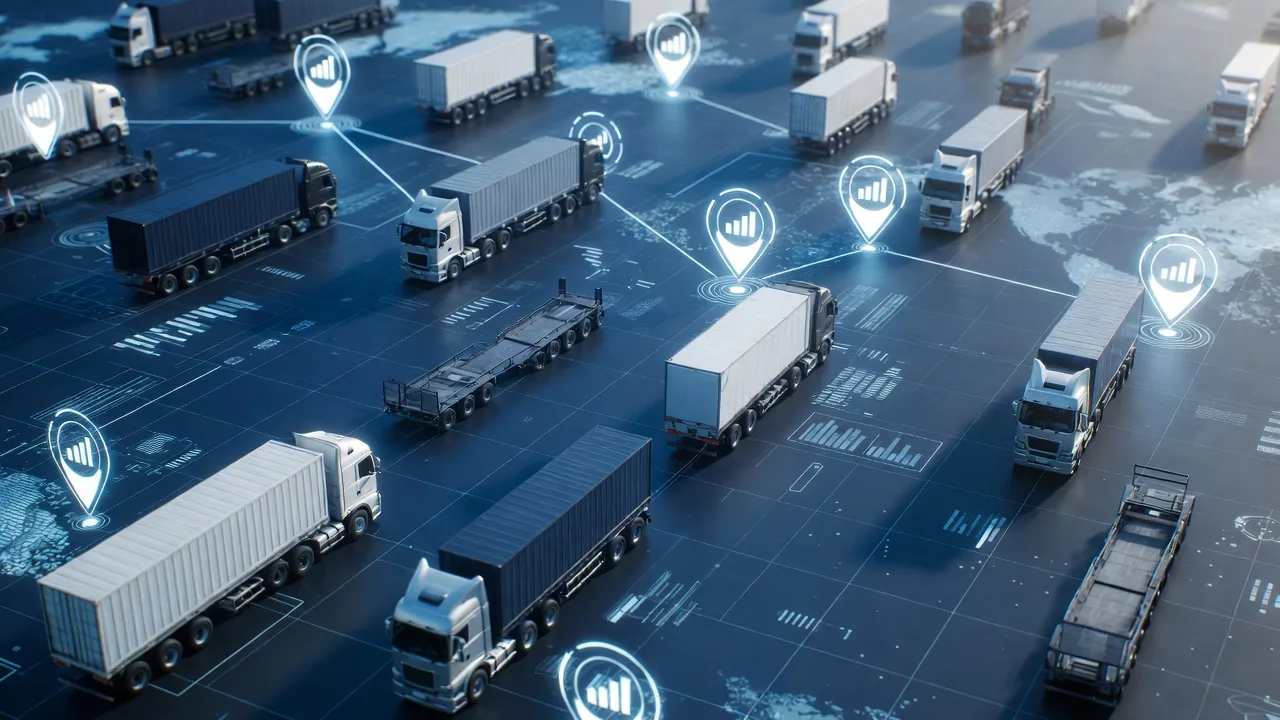
Trucking Software for Small Fleets: How AI Agents Are Redefining Fleet Efficiency at Scale
What Is Trucking Software for Small Fleets?
Trucking software for small fleets is an operational system designed to manage vehicles, drivers, loads, compliance, and costs for fleets typically ranging from 5 to 100 trucks.
Unlike enterprise TMS platforms built for asset-light brokers or mega carriers, small-fleet trucking software focuses on:
- Real-time dispatch and load assignment
- Driver availability and utilization
- Vehicle tracking and maintenance
- Fuel and expense monitoring
- Regulatory compliance
- Customer visibility and reporting
The next generation of these platforms embeds AI agents that actively manage workflows instead of passively recording data.
Why Enterprise Logistics Leaders Care About Small Fleet Technology?
Enterprises increasingly rely on networks of small fleets to achieve regional coverage, faster delivery windows, and cost flexibility. However, unmanaged small fleets introduce risk.
From an enterprise perspective, the problem looks like this:
| Enterprise Concern | Root Issue with Small Fleets |
|---|---|
| Unpredictable delivery performance | Manual dispatch and delayed decisions |
| Compliance exposure | Inconsistent adherence to ELD, HOS, and documentation |
| Cost leakage | Poor fuel control and untracked expenses |
| Limited visibility | Data trapped in spreadsheets or siloed apps |
| Scaling constraints | Each new fleet increases coordination overhead |
Modern trucking software with AI agents solves these problems by acting as a control layer between enterprise freight systems and small fleet operations.
Core Capabilities Enterprise Buyers Expect
Enterprise buyers do not evaluate trucking software based on UI alone. They evaluate how well the system enforces process, reduces exceptions, and scales decision-making.
Foundational Capabilities
| Capability | What Enterprise Buyers Expect |
|---|---|
| Dispatch management | Constraint-based load assignment, not manual drag-and-drop |
| Fleet tracking | Continuous location, status, and ETA accuracy |
| Driver management | Availability, compliance, and performance history |
| Vehicle maintenance | Predictive alerts, not calendar reminders |
| Compliance | Automated HOS, ELD, document validation |
| Cost control | Fuel reconciliation, trip-level profitability |
The Gap in Traditional Software
Most legacy trucking platforms stop at visibility. They show what happened. They do not decide what should happen next.
This is where AI agents enter.
How AI Agents Change Trucking Software for Small Fleets?
AI agents are not dashboards. They are autonomous or semi-autonomous systems that monitor data, detect issues, and take action within defined business rules.
In logistics, this shift matters because decisions are constant and time-sensitive.
AI Agent Functions in Trucking Operations
| Operational Area | What an AI Agent Does |
|---|---|
| Dispatch | Assigns loads based on location, driver hours, fuel cost, and SLA risk |
| Route optimization | Recalculates routes when traffic, delays, or breakdowns occur |
| Compliance | Flags violations before they happen, not after |
| Fuel management | Detects abnormal consumption and reconciles invoices |
| Maintenance | Predicts failures using vehicle telemetry |
| Exception handling | Escalates only high-risk issues to humans |
Instead of managers chasing alerts, AI agents absorb operational complexity.
Dispatch and Load Optimization for Small Fleets
Dispatch is where most inefficiencies originate.
Manual dispatch relies on human memory, intuition, and incomplete data. AI-driven dispatch evaluates thousands of permutations in seconds.
Traditional Dispatch vs AI-Agent Dispatch
| Aspect | Traditional Approach | AI-Agent Approach |
|---|---|---|
| Load assignment | Dispatcher judgment | Constraint-based optimization |
| Driver hours | Checked manually | Continuously monitored |
| SLA risk | Reactive | Predictive |
| Cost impact | Estimated | Calculated per load |
| Scalability | Limited by headcount | Scales with fleet size |
For enterprise buyers, this means consistent outcomes regardless of fleet size or dispatcher experience.
Compliance and Risk Management at Small-Fleet Scale
Compliance failures are expensive, especially when enterprises are indirectly liable through carrier networks.
AI-enabled trucking software enforces compliance at the workflow level.
Compliance Areas Covered by AI Agents
- Hours of Service monitoring and forecasting
- ELD data validation
- Driver document verification
- Load documentation completeness
- Maintenance compliance checks
Instead of auditing after violations occur, AI agents prevent risky actions from being executed in the first place.
Cost Control: Fuel, Maintenance, and Margin Visibility
Small fleets operate on thin margins. Enterprises need confidence that their carrier partners are financially stable and efficient.
AI-driven trucking platforms deliver cost transparency without manual reporting.
Cost Intelligence Capabilities
| Cost Area | AI-Driven Insight |
|---|---|
| Fuel | Consumption anomalies, theft detection |
| Maintenance | Failure prediction, downtime reduction |
| Trip costs | Lane-level profitability |
| Idle time | Root cause identification |
| Driver behavior | Fuel and safety impact |
This data feeds enterprise procurement, carrier scoring, and contract decisions.
Data Integration with Enterprise Systems
Enterprise buyers expect trucking software to integrate cleanly with existing systems.
AI-first platforms are designed as decision layers, not monoliths.
Typical Integrations
- Enterprise TMS platforms
- ERP and finance systems
- Fuel card providers
- Telematics and IoT devices
- Warehouse and yard management systems
The value is not integration itself. It is decision continuity across systems.
Security, Control, and Governance
AI agents do not mean loss of control. Enterprise-grade platforms enforce governance through rule engines and audit trails.
Governance Features Enterprises Expect
| Feature | Purpose |
|---|---|
| Rule-based actions | Prevent unsafe or non-compliant decisions |
| Human-in-the-loop | Escalate only critical cases |
| Explainability | Understand why an AI decision was made |
| Audit logs | Regulatory and contractual traceability |
| Role-based access | Operational and data security |
Without this layer, AI adoption stalls at pilot stage.
How This Positions an AI Logistics Software Builder?
Enterprises are not buying “trucking software.” They are buying operational reliability across fragmented carrier networks.
A company building AI agents for logistics and transportation positions itself as:
- A decision automation partner
- A risk reduction layer
- A scalability enabler for enterprise freight networks
The software becomes infrastructure, not a tool.
Buying Criteria for Enterprise Decision-Makers
When evaluating trucking software for small fleets, enterprise buyers should ask:
- Does the system make decisions or just show data?
- Can AI agents be configured to our business rules?
- How does it prevent compliance failures?
- Can it scale across hundreds of small carriers?
- Is there full auditability and control?
If the answer is unclear, the platform is not enterprise ready.
People Also Ask
A TMS focuses on freight planning and brokerage. Trucking software manages fleet-level execution, including drivers, vehicles, compliance, and costs. AI-driven platforms connect both layers.
Yes. AI agents reduce manual work, making advanced optimization accessible without large operations teams.
They monitor data in real time, predict violations, and block risky actions before they occur, rather than flagging issues after the fact.
Enterprise-grade systems allow AI agents to operate within configurable constraints, approval flows, and escalation thresholds.
By standardizing decisions across many small fleets, AI agents eliminate the coordination bottleneck that limits network growth.