
How UAE Freight Forwarders Can Cut RFQ Response Time by 70%
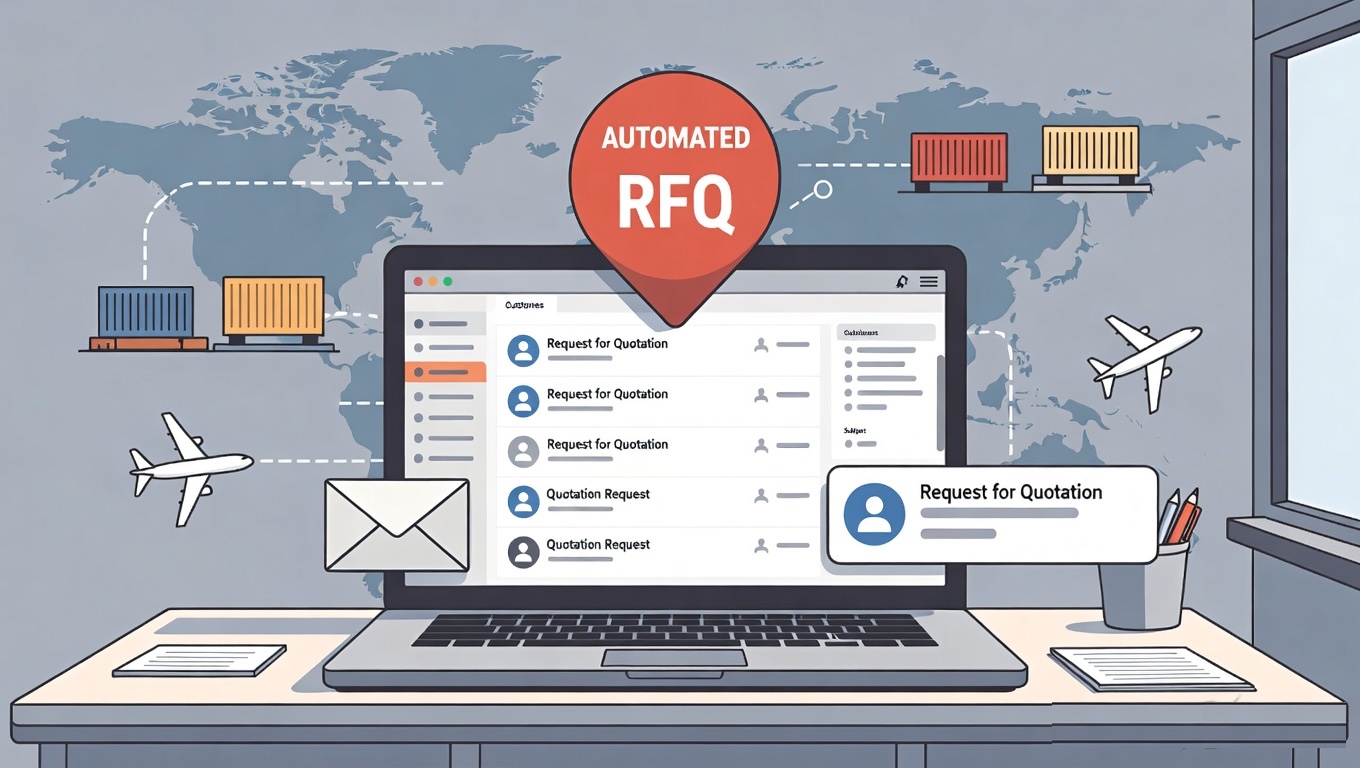
It is 9:30 in the morning in a Dubai freight forwarding office. Three RFQs arrived overnight — one from a regular importer, one from a new prospect, one forwarded by a sales rep with a note that says “urgent, please send today.”
The ops coordinator opens the first email. The customer has sent a table: origin, destination, cargo description, rough weight. A few fields are missing. The second email is a forwarded thread, five messages deep — the actual RFQ is buried somewhere in the middle. The third is a PDF attachment in a format the team has never seen before.
By the time each email is read, understood, and handed off to the right person, 45 minutes have passed. The prospect RFQ — the one that could open a new account — has been sitting in a competitor’s inbox since the same morning. That competitor responds by 11am with a credible quote. Your team responds at 3pm, after two internal messages and a pricing check.
You don’t lose the deal on price. You lose it on speed.
When UAE freight forwarders do a post-mortem on a lost RFQ, the conclusion is usually the same: “Our rates weren’t competitive” or “We needed more time to check with the carrier.” But in most cases, price is not what decided the outcome. Response time did — and the root of the time problem is not pricing complexity.
It is that every RFQ gets treated like a fresh task instead of a repeatable workflow.
The Real Reason UAE Freight Forwarder RFQ Response Is Slow
The sequence your team runs through for every RFQ is always the same:
- Read the email and locate the actual request (often buried in a thread or attachment)
- Understand what the customer is actually asking — because the format is different every time
- Identify what information is missing and go back to the customer
- Check current rates, which means reaching out to someone internally
- Wait for confirmation before committing to a number
- Format the response and send
None of these steps require original thinking. Most require the same questions, the same lookups, the same output structure. Yet each one takes 20–40 minutes because there is no system enforcing consistency across the team.
This is not a people problem. It is the absence of a structured workflow between “email received” and “team starts working on it.”
What UAE Freight Ops Teams are Actually Saying
If you ask a UAE freight ops team why RFQ responses take so long, the answers will always be some version of:
- “Mail comes in different formats — every customer sends it differently”
- “Sometimes they send partial details and we have to go back and ask”
- “We need to check with the pricing team before we can commit to anything”
- “Rates aren’t fixed — it depends on the lane, the cargo, the volume”
- “We can’t respond immediately, we need internal confirmation first”
Each of these is true. None of them is the root cause.
The root cause is the absence of a structured intake between “email received” and “team begins work.” Everything after that depends on individual judgment, memory, and availability. When three people are needed to process one RFQ — the person who reads it, the analyst who checks rates, the manager who approves — the coordination overhead alone takes longer than the actual work.
Research with freight forwarders confirms the scale of this: manual document processing takes between 10 and 60 minutes per document, depending on complexity. (Source: WiseTech Global) Across the industry, process inefficiency of this kind costs an estimated $34.4 billion annually.
The Gap Between What Customers See and What Is Actually Happening
From a customer’s perspective, slow response signals one thing: you are not operationally ready.
That perception is unfair — but it is real. In a competitive UAE freight market where the same RFQ lands with multiple forwarders simultaneously, the one who responds first with a credible, structured quote often wins, regardless of whether they are the cheapest option. Shippers are busy. A quote that arrives in two hours and looks organized beats a quote that arrives in six hours and is more accurate.
Your team knows the delay is not about capability. It is about the absence of a structured handoff between the inbox and the response. The customer does not see that. They see the gap.
The Insight That Changes the Approach
Your team is not slow.
They are re-processing the same thinking for every single RFQ that comes in. The time is not lost in typing the reply. It is lost in:
- Understanding exactly what the customer is asking, because the format changes every time
- Extracting the key fields — origin, destination, cargo type, weight, incoterm, timeline — from unstructured text
- Coordinating internally to get the right information to the right person before a response can be built
This is cognitive work, not creative work. And cognitive work that repeats identically without a system around it is, by definition, automatable.
The goal is not to make your team work faster. It is to reduce the amount of thinking required before they can make the pricing decision. That is where the 70% comes from.
What Structured RFQ Automation Actually Looks Like
This is how RFQ-to-ERP automation works in practice for UAE freight forwarders:
Step 1 — Structured extraction from incoming email or document
The moment an RFQ arrives — whether by email, WhatsApp message, or PDF attachment — it is parsed into a consistent set of fields. Origin, destination, commodity, weight, special handling, incoterm, delivery timeline. If any field is missing or ambiguous, it is flagged before anyone on the team has had to read it.
Step 2 — Missing data identified and followed up immediately
Instead of an ops person reading through an email and realising mid-way that the customer forgot to specify the cargo type, the gap is surfaced at intake. The follow-up message goes out within minutes — not after someone discovers the problem an hour later.
Step 3 — Rate references applied from pre-defined logic
Standard lanes and commodity types do not require a fresh lookup every time. When the route falls within a known parameter set, the rate reference is pulled automatically. For non-standard or negotiated cases, the relevant rate file or carrier contact is surfaced — not searched for from scratch.
Step 4 — Draft response ready for team validation
The team receives a structured draft, not a blank email. Their job is to verify the numbers, apply judgment on any edge cases, and send. They are not building from scratch; they are approving and dispatching.
The shift in team effort: from assembly to judgment.
What This Is Not
It is worth being clear about what structured RFQ automation does not do — because overpromising is how these implementations fail.
- It does not automate pricing decisions. Pricing still requires human validation, especially for complex routes, special cargo, or accounts with negotiated terms. The automation handles intake, extraction, and draft preparation — not the pricing call.
- It does not remove the dependency on your team. Their expertise is the quality control layer. The automation is the intake and preparation layer. Both are necessary.
- It does not make every RFQ instant. Some are genuinely complex and need real internal coordination. The goal is to eliminate the time wasted on the ones that are not — the standard lanes, the repeat customers, the familiar cargo types your team processes the same way every time.
The wins come from removing friction that should not exist. Not from replacing the judgment that should.
The Result: 70% Faster, Not 70% Less Human
UAE freight forwarders using structured RFQ intake typically see:
- 70%+ reduction in time-to-draft for standard lane RFQs
- Fewer back-and-forth cycles with customers over incomplete information
- Ops teams handling 2–3x the weekly RFQ volume without proportional headcount growth
- Faster response on competitive RFQs — which directly affects win rate
The 70% does not come from removing human involvement. It comes from removing the steps that should never have required it in the first place.
Where to Start
If your team handles more than 10 RFQs per week and response times regularly exceed four to six hours, the bottleneck is almost certainly structural — not a people or pricing problem.
The highest-leverage first step is mapping the current flow: from email received to response sent, document every step and every handoff. Once that is visible, the points of unnecessary delay become obvious and the automation design becomes straightforward.
Book a 30-minute session with Nunar to map your RFQ workflow and identify where automation can reduce response time — without touching your pricing logic.
Frequently Asked Questions
Does RFQ automation work if our rates change frequently?
Yes. The automation handles intake and extraction, not pricing. Rate references are pulled from wherever your current rates live — a shared sheet, a TMS, or a rate file. The pricing decision stays with your team; automation means they make that decision on a pre-structured request rather than a raw email thread.
What if customers send RFQs in different formats?
That is exactly what the extraction layer is designed for. Whether it arrives as a structured PDF, a WhatsApp message, or a five-message email thread, the output is a normalised set of fields. Variation in input format does not affect the consistency of the structured output.
How long does it take to implement RFQ automation for a UAE freight company?
For standard email and PDF-based flows, initial implementation typically runs two to four weeks. The first workflows are configured to your specific routes, cargo types, and internal approval rules before going live.