
HS Code Classification for Dubai Customs: Manual Lookup vs AI-Assisted
Ask any experienced UAE clearing agent about HS code classification and the answer is consistent: it is not a lookup task. It is a judgment call. The product description on the commercial invoice, the material composition, the end use, the previous classification history for the same shipper — all of these factor into a correct classification. No online tool gives you a definitive answer. Experience does.
And yet, classification errors remain one of the top three causes of Dubai customs declaration rejections. Not because clearing agents lack knowledge — because the volume of shipments, the inconsistency of supplier-provided descriptions, and the time available per declaration create the conditions where errors occur even in experienced hands.
The question is not whether to automate HS code classification. The question is where human judgment remains essential and where it can be meaningfully supported.
What HS Code Classification Involves in UAE Customs
The Harmonised System (HS) is the internationally standardised nomenclature for classifying traded goods. In the UAE, Dubai Customs uses the GCC Common Customs Law with tariff headings aligned to the World Customs Organization’s HS convention.
Since the UAE’s adoption of the 12-digit HS code requirement, classification has become more specific. Where a 6-digit code once covered a broad product category, the additional 6 digits at the national level distinguish sub-categories, specific materials, and end-use applications. A product that was previously filed under a single heading may now require differentiation based on composition or use that the commercial invoice does not always make explicit.
For a clearing agent, the classification process typically involves:
- Reading the product description on the commercial invoice
- Cross-referencing with the UAE tariff schedule (GCC tariff)
- Checking previous classifications for the same or similar goods from the same shipper
- Verifying that the selected code aligns with the declared value range and origin
- Confirming the code is not on a restricted, controlled, or duty-exemption list that would require additional documentation
For common, repeatedly-handled commodities, this is fast. For new product types, unusual descriptions, or composite goods, it takes real time — time that is rarely available when multiple shipments are moving simultaneously.
Why Manual HS Lookup Breaks Down at Volume
The limitations of manual HS code classification are not a knowledge problem. They are a volume and consistency problem.
Three conditions create classification errors in high-volume clearing operations:
Inconsistent Supplier Descriptions
The quality of product descriptions on commercial invoices varies significantly by shipper. A description of “industrial equipment parts” gives a clearing agent almost nothing to work with for classification. A description of “stainless steel pressure relief valves, 316L, for use in chemical processing plants, rated 40 bar” is classifiable. Most invoice descriptions fall somewhere between these extremes — and the agent must work with what is provided.
Time Pressure Across Concurrent Shipments
A clearing agent working five to ten active shipments simultaneously does not have the time to conduct the same level of classification research on every commodity type. Codes that are uncertain get resolved through pattern-matching against previous shipments. This works well for familiar goods. It creates risk for goods that are slightly different from what has been handled before.
No Cross-Reference Against Current Tariff Changes
HS code schedules are updated. The GCC tariff is revised periodically, and specific headings relevant to high-volume commodity categories can change. Manual classification that relies primarily on established patterns may not catch tariff changes that affect classification for goods the team has filed correctly for years.
The Risk Profile of a Wrong HS Code in Dubai
An incorrect HS code is not just a rejection that requires resubmission. The consequences depend on the nature of the misclassification:
- Duty rate difference — If the correct code carries a higher duty rate than the one filed, reassessment may include back-duty and penalties
- Controlled goods — Some HS codes trigger controlled goods requirements. Filing under an incorrect code may mean required permits or NOCs were not obtained before shipment arrived
- Audit exposure — Consistent misclassification patterns — even unintentional — create audit risk for the clearing agent and the importer
- Shipment hold — Where classification errors suggest misdeclaration, physical inspection may be triggered, adding significant delay
The risk is not theoretical. For clearing agents handling high volumes across diverse commodity types, classification accuracy is both an operational and a compliance matter.
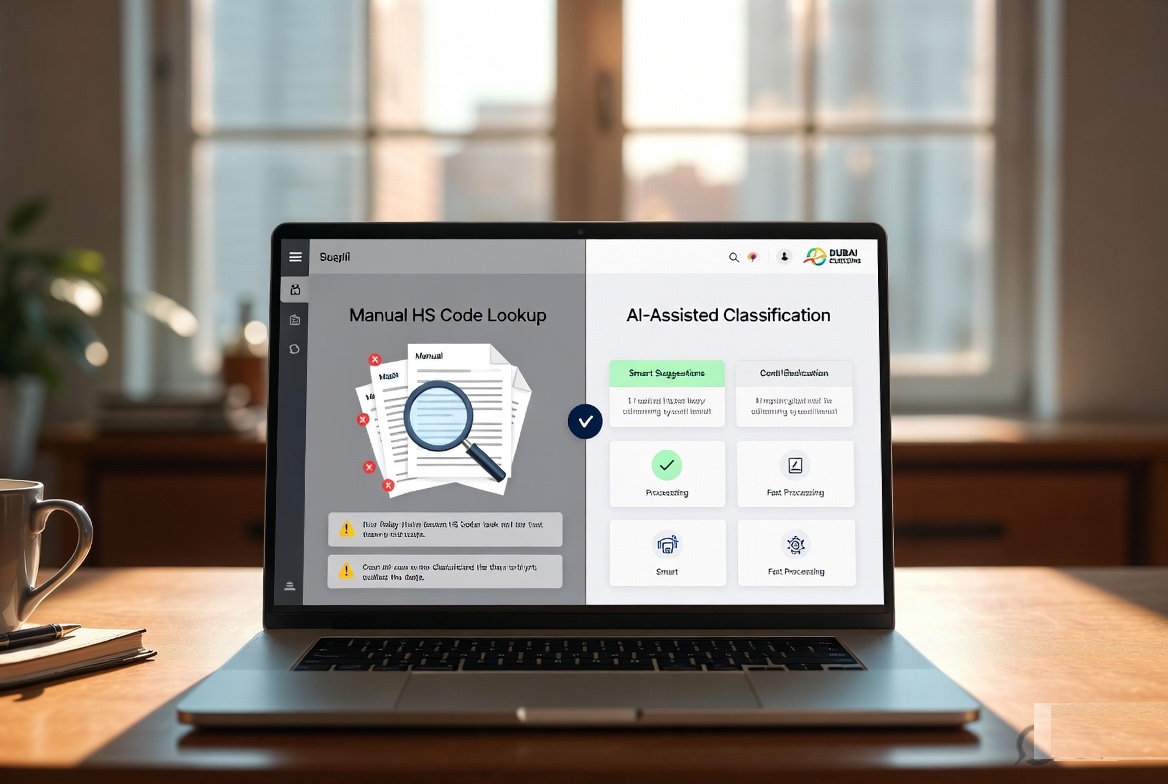
Manual Lookup vs AI-Assisted: What the Difference Actually Means
There is a specific distinction worth making clearly, because it shapes how classification assistance tools should be evaluated.
Full automation means the system selects and applies the HS code without agent review. The classification decision is removed from the operator. This is not appropriate for customs classification work. HS codes carry regulatory and financial consequences. The decision must remain with a qualified, accountable person.
AI-assisted classification means the system analyses the product description — and, where available, previous classification history for similar goods — and presents a suggested HS code with the reasoning for the suggestion. The clearing agent reviews the suggestion, applies their judgment, and confirms or amends the code. The submission uses the agent’s classification decision.
HS classification should be assisted — not automated.
This distinction matters because the experienced clearing agent’s concern about automation is legitimate. They are right not to trust a system that removes them from the classification decision. AI-assisted tools that are designed with this constraint — that present suggestions and support judgment rather than replacing it — address the volume and consistency problem without compromising the accountability structure that licensed customs brokers and clearing agents operate under.
What Good HS Code Assistance Looks Like in Practice
For a UAE clearing agent, an effective HS classification assistance tool should:
- Extract the product description from the commercial invoice automatically, without requiring manual re-entry
- Suggest a 12-digit HS code based on the description, with the relevant tariff heading explanation
- Flag where the description is insufficient for confident classification, prompting the agent to seek clarification from the shipper before filing
- Cross-reference the suggestion against previous classifications for the same shipper and commodity type
- Present the suggestion for agent review and confirmation — never apply it without explicit agent approval
The practical outcome: agents spend less time on routine classifications for familiar goods, and have a documented basis for their classification decisions on less familiar ones. The judgment remains theirs. The research time is reduced.
Where Nunar Supports HS Classification in UAE Customs Workflows
Nunar extracts product descriptions from incoming commercial invoices and generates HS code suggestions based on description content and, where available, shipment history. The suggestion is presented to the clearing agent with the relevant classification context. The agent reviews, confirms, or amends. The code used in the Mirsal 2 declaration is the agent’s decision.
For operations handling high volumes of similar commodity types, this removes the repetitive research overhead on familiar goods while maintaining full agent oversight on the classifications that require it. For less familiar goods, the suggestion provides a starting point that reduces lookup time without removing judgment from the process.
The 12-digit HS code requirement has raised the precision required at the classification stage. The volume of shipments that clearing agents handle has not decreased. AI-assisted classification addresses the gap between the two — not by removing experience from the process, but by reducing the time pressure that makes experience-based judgment difficult to apply consistently.
Summary: HS Code Classification for Dubai Customs
- HS code classification is judgment-based work that depends on product description quality, experience, and knowledge of the UAE tariff schedule
- The UAE’s 12-digit HS code requirement increases the precision required at the classification stage
- Classification errors create rejection, duty reassessment, and audit exposure — not just a resubmission
- Full automation of HS classification is not appropriate — the decision must remain with the qualified clearing agent
- AI-assisted classification tools reduce research time and improve consistency by generating suggestions for agent review, without removing human decision-making from the process
- Free Zone to Mainland Customs Clearance in UAE: The Full Process
- UAE 12-Digit HS Code Requirement: What Clearing Agents Need to Know Before the Deadline
Frequently Asked Questions
What is an HS code in UAE customs?
An HS code (Harmonised System code) is the standardised numerical classification applied to traded goods for customs purposes. In the UAE, Dubai Customs uses 12-digit HS codes aligned to the GCC common customs tariff. The code determines the applicable duty rate, any import restrictions or permit requirements, and how the goods are recorded in trade statistics.
What happens if the wrong HS code is used in a Dubai customs declaration?
Consequences range from declaration rejection and resubmission to duty reassessment, penalty exposure, and shipment hold for physical inspection. Where misclassification is systematic, it can result in audit review of the clearing agent’s operations and, depending on severity, regulatory consequences for both the agent and the importer.
How are HS codes determined for UAE customs?
HS codes are determined by the nature, composition, and use of the goods being traded, classified against the GCC common customs tariff schedule. The process requires reading and interpreting product descriptions, applying classification rules from the HS convention, and cross-referencing against the UAE national tariff subdivisions at the 12-digit level.
Can AI tools classify HS codes for UAE customs?
AI tools can assist with HS code classification by analysing product descriptions and generating suggested codes based on tariff heading definitions and classification history. They should not apply codes without clearing agent review and confirmation. The classification decision — and the regulatory responsibility for it — remains with the licensed customs broker or clearing agent.
How does the UAE 12-digit HS code requirement affect clearing agents?
The 12-digit requirement increases classification specificity, requiring agents to differentiate between sub-categories based on material composition, end use, or other product characteristics that may not always be clear from commercial invoice descriptions alone. This raises the importance of accurate product descriptions from shippers and the value of classification tools that help agents work with incomplete or ambiguous descriptions more efficiently.