
How to Automate Dubai Trade Portal Entries: Step-by-Step for UAE Clearing Agents
Customs automation is not a new concept for UAE clearing agents. The conversation has been happening for years. Most agents have seen demonstrations of tools that promise to transform their workflow. Most have also seen those tools fail to survive contact with the operational reality of a busy clearance desk.
The reason is usually the same: the tool was designed around what automation could technically do, not around how clearing agents actually work. Tools that remove control from the operator or that require the team to change established workflows before seeing any benefit tend to get abandoned — regardless of their technical capability.
This guide covers what customs process automation actually means in a UAE clearing context, how it maps to the existing workflow, and what a realistic step-by-step adoption looks like.
What Customs Automation Actually Means in UAE Clearing Operations
The term “customs automation” covers a wide range of different interventions. It is worth being precise about what is and is not relevant for a UAE clearing agent.
What is not relevant:
- Mirsal 2 replacement — Mirsal 2 is mandated by Dubai Customs. No tool replaces it. Any automation must work with Mirsal 2, not around it.
- RPA bots filing declarations — Robotic process automation approaches that attempt to automate the Mirsal 2 submission itself remove agent oversight from a licensed, regulated activity. This creates compliance risk, not efficiency.
- Full HS code automation — As covered in the HS code classification context, removing agent judgment from classification decisions is not appropriate for licensed customs work.
What is relevant:
- Document intake and extraction — Automatically extracting structured data from commercial invoices, packing lists, and transport documents on receipt
- Cross-document validation — Checking consistency across documents before manual entry begins
- HS code assistance — Generating classification suggestions for agent review
- Data preparation for Mirsal entry — Presenting a validated, ready dataset that reduces the manual transfer required before filing
The distinction matters. Automation that sits before the Mirsal 2 entry step — at the data preparation stage — reduces manual effort and error rates without touching the regulated submission process itself.
Automation should follow your workflow — not replace it.
The Current Workflow: Where Time Is Spent
Before mapping automation to any process, it is useful to be specific about where time actually goes in a typical UAE clearing operation.
Dubai Customs processes approximately 63,000 declarations daily across the trade ecosystem. For the clearing agents that feed those declarations, the pre-filing preparation phase typically accounts for the majority of time per shipment — not the actual Mirsal 2 entry.
The standard pre-filing sequence:
- Document receipt — Commercial invoice, packing list, bill of lading, and supporting documents arrive by email, WhatsApp, or client portal. Often in multiple messages, sometimes incomplete.
- Document review and completeness check — The agent reviews what has arrived, identifies missing documents, and follows up with the shipper or freight forwarder.
- Data extraction — Relevant fields are manually read from each document and transferred to a staging area — a spreadsheet, a template, or directly into Mirsal 2.
- HS code lookup — The agent determines the appropriate 12-digit code, cross-referencing against the tariff schedule and previous shipments.
- Supervisor review — A senior team member checks the prepared declaration before submission.
- Mirsal 2 entry and submission — The validated data is entered into the Dubai Trade Portal and the declaration is submitted.
Steps 2, 3, and 4 are where most of the manual effort is concentrated and where most pre-filing errors are introduced. These are also the steps where automation delivers the clearest value — without requiring any change to the submission process itself.
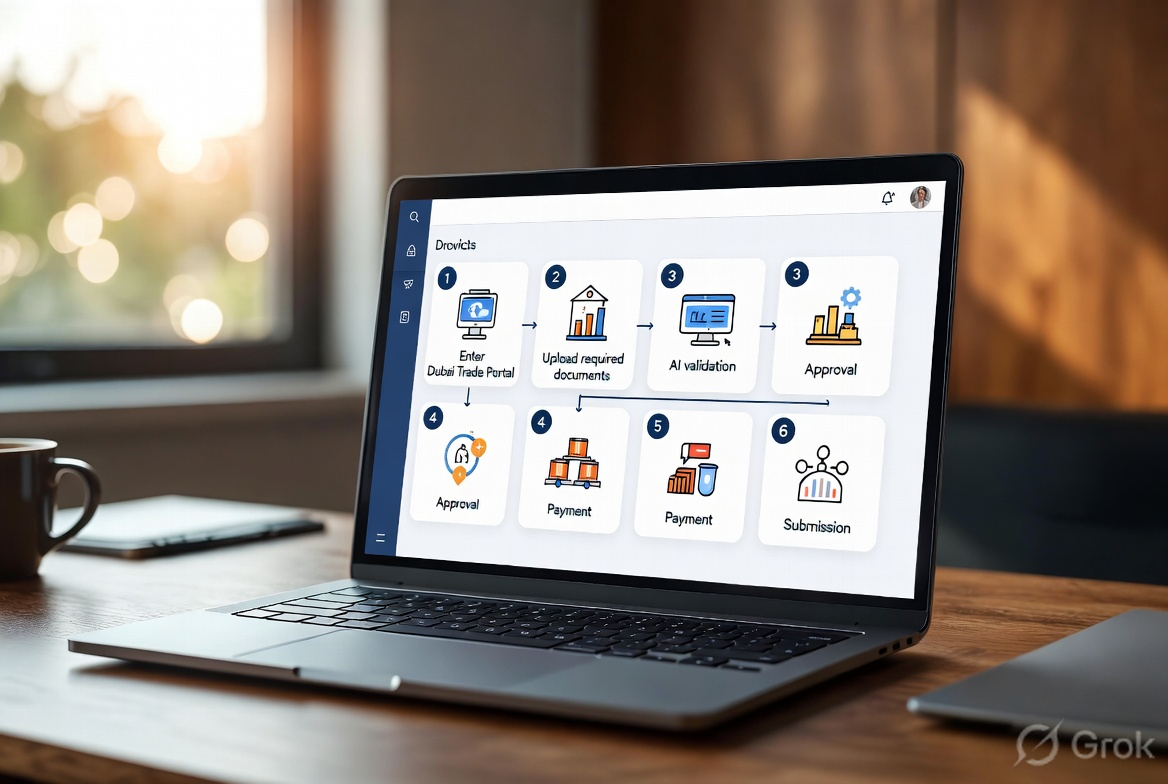
Step-by-Step: How Automation Maps to the Clearing Workflow
Step 1 — Automated Document Intake
Documents arriving by email are automatically detected, extracted, and classified by type — commercial invoice, packing list, airway bill, certificate of origin. This eliminates the manual sorting step and ensures that the completeness check begins the moment documents arrive rather than when an agent finds time to process the inbox.
For clearing operations receiving 30–100 shipment document sets per day, the time difference between manual inbox processing and automated intake is significant.
Step 2 — Structured Data Extraction
Once documents are classified, data extraction pulls the relevant fields from each document into a structured format. Consignee details, values, weights, descriptions, package counts, transport references — extracted from the document, not retyped by the agent.
This is where manual data transfer errors are eliminated. The extraction happens from the source document directly. The agent reviews the extracted data rather than producing it.
Step 3 — Cross-Document Validation
Extracted data from multiple documents is automatically compared. Value on the commercial invoice against the declared value. Consignee name across invoice and packing list. Gross weight across packing list and bill of lading. Description consistency across documents and against the HS code being applied.
Discrepancies are flagged for agent review before any Mirsal 2 entry begins. This shifts the error detection point from post-rejection to pre-filing — which is the difference between a 30-second correction and a 2-day rework cycle.
Wrong HS codes alone add 2 to 5 days to clearance time when amendment is required after submission. Catching them at this stage removes that cost from the workflow entirely.
Step 4 — HS Code Assistance
Based on the extracted product description and available classification history, a suggested HS code is generated for agent review. The agent confirms or amends. The code used in the declaration is the agent’s decision — the system removes the research time, not the judgment.
Step 5 — Validated Data Ready for Mirsal Entry
The output of the automated preparation process is a checked, structured dataset that the agent uses for Mirsal 2 entry. The entry itself remains a manual, supervised process. What changes is what the agent is working from — validated data rather than raw documents.
Step 6 — Mirsal 2 Entry and Submission (Unchanged)
The declaration is entered into the Dubai Trade Portal and submitted by the licensed agent. No change to this step. The compliance structure, agent oversight, and regulatory accountability remain exactly as they are today.
What Clearing Agents Need to See Before Adopting Any Automation Tool
Based on consistent feedback from UAE clearing operations evaluating automation tools, the concerns that determine adoption are practical rather than technical:
- Does it work with the documents we actually receive? — Invoices in Arabic and English, inconsistent formatting, scanned PDFs, handwritten packing lists. A tool that only handles clean, digital documents is not a real-world solution.
- Does it require rebuilding our workflow? — Teams that have to change how they work before seeing any benefit will not adopt. The tool needs to fit the existing process, not require process redesign as a prerequisite.
- Does the team remain in control? — Agents need to trust that they can override any suggestion, that the system is transparent about what it has extracted and from where, and that accountability for the declaration remains theirs.
- What happens when it gets it wrong? — Every document intelligence tool makes extraction errors. The question is whether errors are visible and easy to correct before they reach Mirsal 2.
These are the right questions. Any automation tool that cannot answer them clearly is not ready for production use in a UAE clearance operation.
Where Nunar Fits Into This Workflow
Nunar addresses steps 1 through 4 in the workflow described above — document intake, data extraction, cross-document validation, and HS code assistance. It is designed specifically for the UAE customs clearance context, handling the document types and formats that clearing agents in Dubai actually work with.
The Mirsal 2 entry step remains with the agent. The output of the Nunar preparation process is a validated dataset — not a filed declaration. The agent reviews the prepared data, confirms the HS classification, and proceeds with submission through the Dubai Trade Portal as they do today.
For operations where manual data extraction is currently the primary time cost in the pre-filing workflow, the practical gain is in reduced preparation time per declaration and fewer post-rejection rework cycles. For the clearing agent, the experience is not of automation replacing judgment — it is of preparation requiring less manual effort while maintaining the same level of control.
Summary: Customs Automation for UAE Clearing Agents
- Relevant customs automation addresses data preparation before Mirsal 2 entry — not the filing process itself
- Document extraction, cross-document validation, and HS code assistance are the three stages where automation delivers clear value in the UAE clearing workflow
- The Mirsal 2 entry and submission steps remain with the licensed agent — automation does not change the regulatory or compliance structure
- The right evaluation criteria for any automation tool: document format compatibility, workflow fit, agent control, and visible error handling
- Dubai Customs processes 63,000 declarations daily — for the operations feeding those declarations, pre-filing preparation efficiency is a direct competitive factor
Frequently Asked Questions
Can customs clearance in UAE be automated?
The data preparation phase — document intake, field extraction, cross-document validation, and HS code assistance — can be significantly automated. The declaration filing through Mirsal 2 and the Dubai Trade Portal must remain under the oversight of a licensed customs broker or clearing agent. Automation in the UAE customs context means reducing manual effort in preparation, not removing agents from the submission process.
What is the Dubai Trade Portal?
The Dubai Trade Portal is the digital platform through which UAE trade facilitation services are accessed, including Mirsal 2 for customs declarations, free zone portal connections, and port community system interactions. All imports, exports, and re-exports through Dubai require declaration submission through the Dubai Trade Portal.
How does customs automation affect HS code classification?
AI-assisted classification tools can analyse product descriptions from commercial invoices and suggest appropriate HS codes for agent review. The classification decision remains with the clearing agent. This approach reduces the time required for routine classification while maintaining the human judgment required for accurate, accountable classification under UAE customs regulations.
What documents are needed for Dubai customs clearance?
A standard Dubai customs clearance requires a commercial invoice, packing list, and bill of lading or airway bill. Depending on the goods category, additional documents may include a certificate of origin, import permit, health certificate, or conformity certificate. The clearing agent reviews document completeness at intake before preparing the Mirsal 2 declaration.
How long does Dubai customs clearance take?
For well-documented shipments with accurate declarations, Dubai Customs assigns clearance through a channel system. Green channel declarations are released automatically with electronic duty assessment. Yellow channel declarations require document review, typically resolved within hours. Red channel assignments involve physical inspection and typically add 1 to 3 business days. Pre-filing errors that require declaration amendment after submission add between 2 and 5 days depending on the nature of the correction required.
Key Statistics
- Dubai Customs processes approximately 63,000 customs declarations daily — pre-filing preparation efficiency directly determines how much of that capacity a clearing operation can handle
- 98% of Mirsal 2 transactions are completed without human intervention on the customs side — accuracy of the submitted data is what determines throughput
- HS code errors add 2 to 5 days to clearance when amendment is required after submission
- The Smart Workspace platform has saved UAE companies 1.4 million work hours through process efficiency improvements
- Declaration amendments carry a fine of AED 500 — avoidable through pre-filing cross-document validation
Further Reading
- What Is Mirsal 2? A Guide for UAE Clearing Agents and Freight Forwarders
- Why Dubai Customs Declarations Get Rejected — and What UAE Clearing Agents Can Do
- HS Code Classification for Dubai Customs: Manual Lookup vs AI-Assisted
- Dubai Trade & Customs Clearance Automation — Nunar for UAE Clearing Agents
- Free Zone to Mainland Customs Clearance in UAE: The Full Process
- UAE 12-Digit HS Code Requirement: What Clearing Agents Need to Know Before the Deadline