
Why Dubai Customs Declarations Get Rejected — and What UAE Clearing Agents Can Do
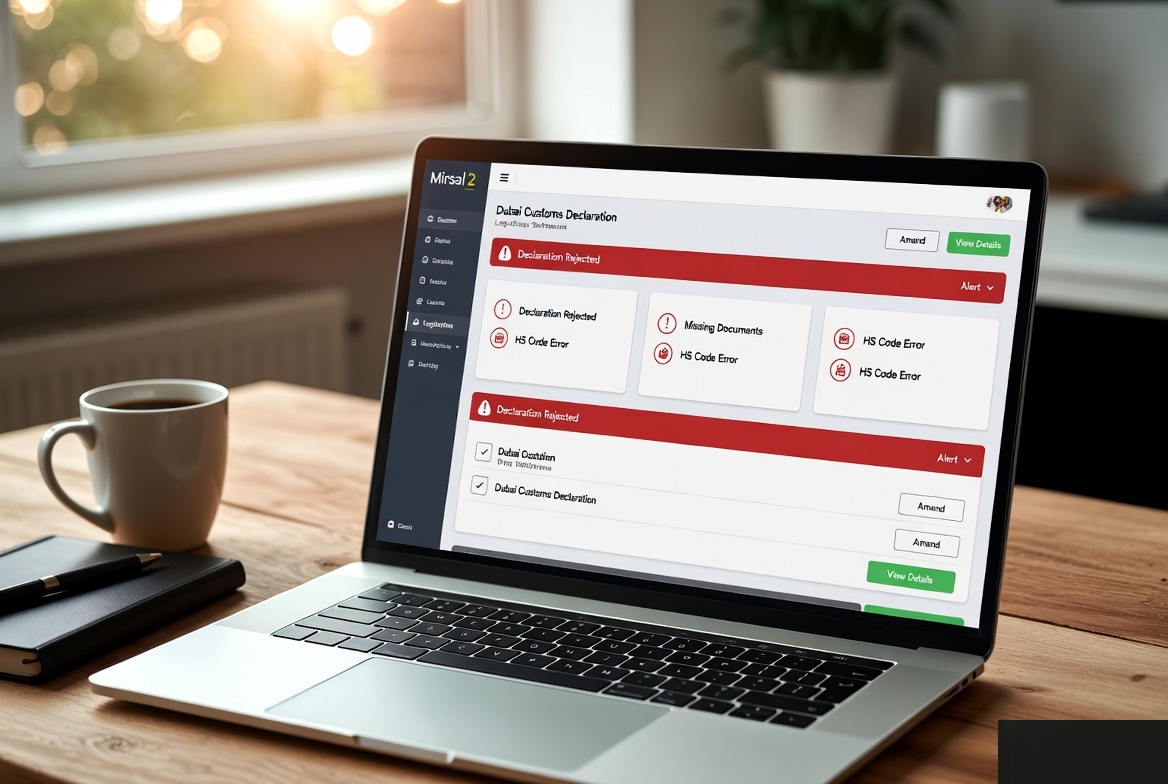
Every UAE clearing agent knows the feeling. A declaration is submitted through the Dubai Trade Portal. A few hours later — or the next morning — a rejection notification arrives. The shipment is held. The customer is calling. The rework begins.
A rejection rate of 10–15% is widely accepted across clearance operations in Dubai as an unavoidable cost of doing business. It is not. Most customs declaration rejections are preventable. And they rarely start inside Mirsal 2.
Where Rejections Actually Come From
The common assumption is that a customs declaration rejection means something went wrong during the filing process — a missed field, a system error, an incorrect submission sequence. In practice, the root cause is almost always earlier in the workflow.
The three most frequent sources of Dubai customs declaration rejections are:
1. Document Mismatches
The commercial invoice, packing list, and bill of lading (or airway bill) are prepared by different parties — the shipper, the freight forwarder, the carrier. By the time they reach the clearing agent, inconsistencies have often already been introduced. A consignee name with a different spelling. A gross weight that differs by a few kilograms. A description that does not match across documents.
When these documents are entered into Mirsal 2, the inconsistencies become declaration errors. Dubai Customs cross-references declared data against submitted documents. Any mismatch is grounds for rejection.
2. Uncertain or Incorrect HS Codes
HS code classification is experience-based work. For clearing agents handling diverse commodity types across many clients, maintaining consistent classification accuracy under time pressure is genuinely difficult. Manual lookup against the UAE tariff schedule, cross-referenced with previous shipment history, takes time — and time is rarely available in a high-volume operation.
An incorrect HS code does not just cause a rejection. Depending on the commodity and the degree of misclassification, it can trigger duty reassessment, audit review, or shipment hold pending inspection. The cost of a wrong code is rarely limited to the rework of a single declaration.
3. Value Discrepancies
Declared customs value must align with the commercial invoice and, where applicable, with Dubai Customs benchmarks for similar goods. Discrepancies between the declared value and invoice value — whether from data entry error, currency conversion, or an invoice that does not reflect actual transaction value — are a consistent source of rejections and additional scrutiny.
The Pressure Clearing Agents Are Operating Under
Understanding why rejections remain common requires understanding the operational context clearing agents work in.
Pressure comes from three directions simultaneously:
- Customers — Shipment delays caused by declaration rejections have direct commercial consequences for importers. Customer escalations over held cargo arrive while the clearing agent is still in the middle of the rework.
- Internal operations — Rejected declarations disrupt daily processing targets and create SLA breaches that accumulate across a month of high-volume activity.
- Compliance — Each rejection creates a record. Consistent rejection patterns draw attention from auditors. The compliance risk of normalised high rejection rates is not always visible day to day, but it compounds over time.
Operating under this pressure while managing manual data extraction from multiple documents across dozens of simultaneous shipments creates exactly the conditions in which preparation errors occur. Not from a lack of skill — from a system that depends too heavily on individual attention at every step.
Why Cross-Document Validation Is the Missing Step
The standard pre-filing process in most UAE clearing operations involves a supervisor review before submission. The reviewer checks the Mirsal 2 entry against the key document fields — value, HS code, consignee details. This catches some errors. It does not catch inconsistencies that exist between documents that the reviewer is not comparing side by side.
A systematic cross-document validation step — running the commercial invoice, packing list, and transport document against each other before a single field is entered into Mirsal 2 — changes the error detection point. Instead of discovering a mismatch after rejection, it surfaces during preparation, when correction is straightforward.
Rejections don’t happen in Mirsal. They happen inside your documents — before you even file.
The clearing agents reducing rejection rates in Dubai are not filing differently. They are preparing differently.
What Effective Pre-Filing Validation Looks Like
A structured pre-filing validation process for a UAE customs declaration should check:
- Consignee and party consistency — Names, addresses, and trade licence references match across all documents
- Value alignment — Declared value matches commercial invoice value; currency is consistent; incoterms are reflected correctly
- Weight and quantity — Gross and net weights match between invoice and packing list; package count is consistent
- Description consistency — Product descriptions are aligned across documents and support the HS code being applied
- Origin documentation — Certificate of origin is present where required and the declared country of origin is consistent across documents
- HS code plausibility — The applied code is consistent with the product description and does not conflict with previous classifications for similar goods from the same shipper
In most current workflows, this level of cross-document checking depends entirely on the reviewing agent’s time and attention. Under operational pressure, it is the step most likely to be compressed.
The Role of Document Intelligence in Reducing Rejection Rates
Document intelligence tools address the pre-filing validation gap by extracting structured data from incoming documents automatically and running cross-document checks before manual entry begins. This shifts the error detection point from post-rejection rework to pre-filing preparation.
The practical effect for a clearing operation:
- Document mismatches are flagged before entry, not discovered after rejection
- HS code suggestions are generated from product descriptions with context from shipment history, reducing the time and uncertainty of manual classification
- Value and weight inconsistencies are identified at intake, allowing correction before the declaration is prepared
Nunar is built specifically for this pre-filing stage of the UAE customs clearance workflow. It extracts data from commercial invoices, packing lists, and transport documents, validates consistency across them, and presents clearing agents with a checked dataset for Mirsal 2 entry. The HS code classification remains a human decision — Nunar suggests, the agent confirms.
For operations where 10–15% rejection rates have become normalised, the reduction in rework hours, customer escalations, and compliance exposure is the practical case for addressing preparation rather than filing.
Summary: Reducing Dubai Customs Declaration Rejections
- Most Dubai customs declaration rejections originate from pre-filing data preparation errors, not from Mirsal 2 itself
- Document mismatches, incorrect HS codes, and value discrepancies are the three dominant rejection causes
- Rejections create compounding costs — customer escalations, SLA breaches, compliance exposure — beyond the immediate rework
- Cross-document validation before filing is the most effective single change to reduce rejection rates
- Document intelligence tools make systematic pre-filing validation operationally practical for high-volume clearing agents
- Free Zone to Mainland Customs Clearance in UAE: The Full Process
- UAE 12-Digit HS Code Requirement: What Clearing Agents Need to Know Before the Deadline
Frequently Asked Questions
What are the most common reasons for Dubai customs declaration rejection?
The most common causes are document mismatches between the commercial invoice, packing list, and transport document; incorrect or inconsistent HS code classification; and value discrepancies between the declared value and the commercial invoice. Most of these errors originate during manual data preparation before the declaration is submitted through Mirsal 2.
How long does it take to resolve a rejected Dubai customs declaration?
Resolution time depends on the nature of the rejection. A simple data correction can often be resolved and resubmitted within a few hours. Rejections requiring document amendments from the shipper, HS code reassessment, or customs query responses can extend to one or more working days, with corresponding shipment delays.
Can rejection rates be reduced without additional staffing?
Yes. The primary driver of rejection rates in most clearing operations is the volume of manual data handling at the preparation stage, not staff capability. Improving the pre-filing validation process — through structured cross-document checking or document intelligence tools — reduces error rates without increasing headcount.
Does Dubai Customs track rejection rates by clearing agent?
Dubai Customs maintains compliance records for licensed customs brokers and clearing agents. Consistent patterns of rejection or correction can factor into compliance assessments. Reducing rejection rates is not only an operational efficiency measure — it is relevant to the compliance standing of the clearing operation.
What is the difference between a rejection and a query in Mirsal 2?
A rejection means the declaration has not been accepted and must be corrected and resubmitted. A customs query means the declaration has been received but additional information or documentation is required before processing can continue. Both create delays, but queries typically require document provision rather than full resubmission.