
UAE 12-Digit HS Code Requirement: What Clearing Agents Need to Know Before the Deadline
Most customs clearance problems do not start in customs. They start in documents that arrived days earlier — a commercial invoice with a product description too vague to classify confidently, a packing list with weights that do not reconcile with the bill of lading, a certificate of origin that does not match the declared origin on the invoice.
By the time these documents reach the Dubai Trade Portal, the error is already embedded. The clearing agent either catches it during preparation — creating a delay while corrections are sought from the shipper — or does not catch it, and the declaration is rejected after submission.
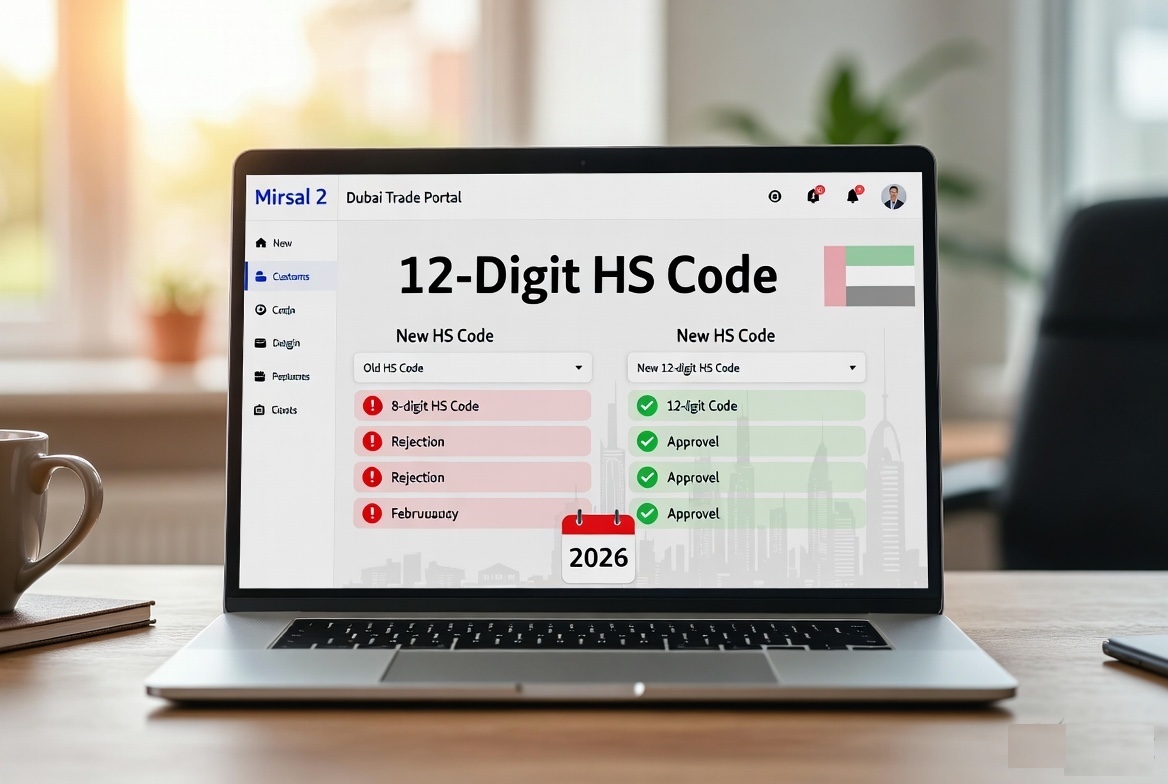
The UAE’s 12-digit HS code requirement has raised the cost of document quality problems. What a vague product description could previously absorb at a 6-digit classification level now creates genuine classification uncertainty at the 12-digit level. The quality of what is written on the commercial invoice has a direct line to the accuracy of the customs declaration.
What Changed With the UAE 12-Digit HS Code Requirement
The Harmonised System uses a 6-digit code structure internationally. The GCC common customs tariff extends this to 8 digits at the regional level. The UAE’s implementation adds further national subdivisions to reach 12 digits for specific commodity categories.
The practical effect for clearing agents:
- A product previously classified at a single 8-digit heading may now require differentiation at the 12-digit level based on material composition, end use, or manufacturing method
- These differentiating factors are often not stated on the commercial invoice because the shipper does not know they are required for the importing country’s classification
- An agent working from an invoice that describes goods as “industrial components” rather than “stainless steel pressure relief valves, 316L grade, 40-bar rated, for chemical processing” faces a classification problem that originates with the document, not with the classification process
This is the document quality problem in practice. The clearing agent has the knowledge to classify correctly. They do not have the information on the invoice to do so with confidence.
How Commercial Invoice Quality Affects the Entire Clearance Process
The commercial invoice is the source document for most of the data in a customs declaration. Its quality determines the quality of what can be prepared from it.
A high-quality commercial invoice for UAE customs purposes includes:
- A specific, descriptive product description — sufficient to support 12-digit HS classification without additional inquiry
- Material composition where relevant — particularly for metals, textiles, chemicals, and electronic components
- End use or application where it affects classification — industrial vs. consumer, medical vs. general purpose
- Country of origin that is clearly stated and consistent with other documents
- Declared value in the transactional currency with incoterms clearly stated
- Consignee details that match the import permit or trade licence where applicable
A low-quality commercial invoice for UAE customs purposes has generic product descriptions, missing material specifications, inconsistent party details, and a declared value that does not clearly reflect the transaction terms.
Dubai Customs processes approximately 63,000 declarations daily, with 98% completed without human intervention on the customs side. The declarations that trigger queries or rejections tend to share one characteristic: the source documents did not contain sufficient or consistent information to support a clean filing.
Customs delays don’t start in customs. They start in your documents.
The Upstream Problem: Why Shippers Send Incomplete Documents
Shippers in origin countries prepare commercial invoices to meet their own export requirements. UAE customs classification requirements — particularly at the 12-digit HS level — are not visible to them unless the clearing agent or importer communicates them explicitly.
This creates a consistent pattern in UAE clearing operations:
- Documents arrive with product descriptions adequate for export but insufficient for UAE import classification
- The clearing agent identifies the gap during preparation — either through experience with the commodity type or when a classification tool flags insufficient description for confident 12-digit coding
- The agent contacts the shipper or freight forwarder to request a corrected or supplemented invoice
- The delay between document arrival and correct document receipt represents preparation time that cannot be recovered
For clearing agents handling high volumes, this cycle repeats across multiple shipments daily. The time cost is not in the customs system — it is in the communication loop created by document quality problems that could have been prevented upstream.
The Impact of Document Quality Problems on Clearance Outcomes
When document quality problems are not caught before filing, the consequences extend beyond the individual declaration:
HS Code Misclassification
An agent who classifies based on insufficient description may apply a code that is technically defensible at 6 digits but incorrect at 12. Dubai Customs may query the classification, triggering an amendment process that adds 2 to 5 days to clearance and carries an amendment fine of AED 500.
Value Discrepancy
An invoice that does not clearly state incoterms creates uncertainty about whether the declared value includes or excludes freight and insurance. If the declared customs value does not align with Dubai Customs valuation benchmarks for similar goods, the declaration may be queried for customs valuation evidence — requiring the importer to provide additional documentation and extending clearance time.
Controlled Goods Without Permits
An invoice description generic enough to classify under a non-controlled heading may, when examined during inspection, describe goods that fall under a controlled category requiring prior permits. Discovery during physical inspection is significantly more disruptive than identification at the pre-filing document review stage.
Origin Documentation Inconsistency
Where a preferential duty rate is being claimed, the origin declaration on the commercial invoice must be consistent with the certificate of origin and the shipping documentation. Inconsistency — even minor — creates grounds for rejection of the preferential claim and potential re-assessment at the standard rate.
What Clearing Agents Can Do About Upstream Document Quality
Clearing agents cannot control what shippers put on commercial invoices. They can influence it — but the more practical question is how to manage document quality problems efficiently when they arrive rather than how to prevent them entirely.
The approaches that reduce the time cost of document quality issues:
Document Completeness Check at Intake
A systematic check at the point of document receipt identifies missing information before preparation begins. Rather than discovering a classification problem during Mirsal 2 entry, the agent knows at intake that the product description is insufficient for 12-digit HS coding and initiates the shipper communication immediately.
The earlier in the workflow a gap is identified, the less it disrupts the declaration timeline. A shipper contacted at document receipt can usually provide supplemental information within hours. A shipper contacted after a customs rejection is responding to an active query with a delayed shipment as context — a different conversation, with a different timeline.
Communicating UAE Requirements to Repeat Shippers
For clearing agents with regular shippers, providing clear invoice requirements for UAE customs — specifically what product description information is needed for 12-digit classification — reduces the rate of incomplete documents over time. This is most practical for clearing operations with concentrated shipper relationships rather than one-off shipments.
Flagging Classification Uncertainty Early
When a product description is insufficient for confident 12-digit classification, flagging this before Mirsal 2 entry allows the agent to seek clarification or make a documented classification decision rather than proceeding with uncertainty. A classification that is flagged, reviewed, and confirmed at the preparation stage is defensible. One that is filed under time pressure without adequate description is a future amendment waiting to happen.
Where Nunar Addresses the Document Quality Problem
Nunar’s document intake process includes a completeness and quality check at the point of document receipt. For each incoming shipment, the system assesses whether the commercial invoice contains sufficient information for the declaration fields it needs to populate — including product description adequacy for HS code assistance.
Where description gaps are identified, the agent is alerted before extraction and preparation begin. The shipper communication happens at intake, not during Mirsal 2 entry. For 12-digit HS code scenarios where description is insufficient for confident classification, Nunar flags the gap explicitly rather than generating a speculative suggestion — keeping the classification decision with the agent while removing the risk of proceeding with inadequate information.
The commercial invoice quality problem is upstream of Nunar, upstream of the clearing agent, and upstream of Dubai Customs. What Nunar addresses is where that upstream problem enters the clearance workflow — and how early it is identified before it becomes a rejection, an amendment, or a delayed shipment.
Summary: Commercial Invoice Quality and UAE Customs Clearance
- Commercial invoice quality directly determines the accuracy of UAE customs declarations — vague descriptions create classification uncertainty, inconsistent values create query risk, missing permits create inspection exposure
- The UAE 12-digit HS code requirement increases the product description detail needed on commercial invoices for accurate classification
- Document quality problems caught at intake can be resolved in hours. Problems discovered at or after submission add 2 to 5 days to clearance and may carry AED 500 amendment fines
- A systematic completeness check at document receipt — before preparation begins — is the most practical intervention for reducing the time cost of upstream document quality issues
- Clearing agents cannot control what shippers put on invoices. They can control when and how document quality problems enter their workflow
Frequently Asked Questions
What should a commercial invoice include for UAE customs clearance?
A commercial invoice for UAE customs purposes should include a specific product description (sufficient for 12-digit HS classification), material composition where relevant, country of origin, declared value with currency and incoterms, gross and net weight, package count, consignee details matching the import licence, and document references including invoice number and shipping document reference.
What is the UAE 12-digit HS code requirement?
The UAE extends the standard 6-digit international Harmonised System code to 12 digits for specific commodity categories through national tariff subdivisions beyond the GCC 8-digit common customs tariff. The additional digits require greater product specificity in classification — differentiation based on material composition, end use, or manufacturing method that the 6-digit or 8-digit level does not require.
What happens if a commercial invoice has incorrect information for Dubai customs?
Incorrect information on the commercial invoice that carries through to the declaration may result in declaration rejection, customs query, or valuation challenge. Correction requires a document amendment from the shipper and a declaration amendment through the Dubai Trade Portal — carrying an AED 500 amendment fine and adding clearance time depending on how quickly the shipper can provide corrected documentation.
How does product description quality affect HS code classification in UAE?
The product description on the commercial invoice is the primary source for HS code classification. At the 12-digit UAE tariff level, descriptions that are sufficient for 6-digit classification may not provide enough specificity for accurate sub-category differentiation. Clearing agents working from generic descriptions must either seek additional information from the shipper or make a classification judgement with incomplete information — both of which create delay or risk.
Can document quality issues be detected before customs submission?
Yes. A systematic completeness and consistency check at the point of document receipt identifies gaps in product description, missing origin documentation, value inconsistencies, and permit requirements before the declaration is prepared. Identifying these issues at intake rather than during or after submission significantly reduces the time and cost of resolution.
Key Statistics
- Dubai Customs processes approximately 63,000 declarations daily — declarations with incomplete or inconsistent source documents are the primary source of the queries and rejections that disrupt this flow
- HS code errors — often caused by insufficient product description on source invoices — add 2 to 5 days to clearance when amendment is required after submission
- Declaration amendments carry a fine of AED 500, with a Dubai Customs exemption available from January 2026 for sea cargo with pre-arrival submission and 72-hour amendment completion
- The UAE recorded AED 5.23 trillion in total trade in 2024 — the volume of declarations flowing from this activity makes pre-filing document quality a systemic operational challenge, not an occasional exception
- 98% of Mirsal 2 transactions complete without customs-side human intervention — meaning it is the quality of what clearing agents submit, not the speed of the customs system, that determines clearance outcomes
Further Reading
- What Is Mirsal 2? A Guide for UAE Clearing Agents and Freight Forwarders
- Why Dubai Customs Declarations Get Rejected — and What UAE Clearing Agents Can Do
- HS Code Classification for Dubai Customs: Manual Lookup vs AI-Assisted
- How to Automate Dubai Trade Portal Entries: Step-by-Step for UAE Clearing Agents
- Free Zone to Mainland Customs Clearance in UAE: The Full Process
- Dubai Trade & Customs Clearance Automation — Nunar for UAE Clearing Agents